


02 September 2012
NEW BISHOP FOR AMERICAN CARPATHO-RUSYN ORTHODOX DIOCESE
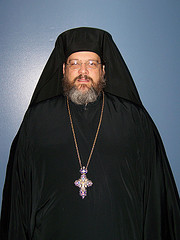 |
| Very Reverend Archimandrite Grigorios Tatsis
JOHNSTOWN, PA – The Holy and Sacred Synod of the Ecumenical Patriarchate of
Constantinople on Thursday, August 30, 2012, elected unanimously the
Very Reverend Archimandrite Grigorios Tatsis to be the Diocesan Bishop of the
American Carpatho-Russian Orthodox Diocese of the USA with the title of Bishop
of Nyssa. His name was submitted to the Holy and Sacred Synod of the Ecumenical
Patriarchate by His Eminence, Archbishop Demetrios of America, Locum Tenens of
the American Carpatho-Russian Orthodox Diocese of the USA, following the
submission of his candidacy by the diocesan priests at a Special Assembly
convened on July 14, 2012 at Christ the Saviour Cathedral.
The newly elected bishop will travel
to Constantinople for the official ceremonies of announcement and acceptance,
known as Mikro and Mega Minima, which will take place at the Ecumenical
Patriarchate. His ordination to the episcopacy and enthronement as Diocesan
Bishop will take place later, on a date to be determined, at the
Carpatho-Russian Cathedral in Johnstown, PA.
His Grace, Bishop-elect Grigorios (Gregory) was born in Charlotte, NC on Dec
7, 1958, with the baptismal name of George, the first of two children of Peter
and Antonia Tatsis. He is a graduate of the University of North Carolina at
Chapel Hill earning a BA degree in Biology (1981) and the University of North
Carolina at Charlotte earning a MS degree in Biology (1989). Working for more
than 20 years in the field of Cardiovascular Research at Carolinas Medical
Center in Charlotte, NC, he authored/co-authored over one hundred articles,
abstracts, and book chapters.
A true son of the Church, from his early youth Bishop-elect Grigorios served
in his home parish of Holy Trinity Greek Orthodox Cathedral in Charlotte, NC in
various capacities including altar server, Sunday School teacher for 13 years
and in several leadership positions including Parish Council President. He was
also a founding member of St. Nektarios Greek Orthodox Church in Charlotte, NC
where he served on the Parish Organizing Committee, as Sunday School teacher
for four years, as a member of the choir and as its first parish council
president.
After taking part in a mission trip to Alaska sponsored by the Orthodox
Christian Mission Center, Bishop-elect Grigorios felt the calling to pursue his
life-long dream of studying for the Holy Priesthood. Leaving his secular job in
early 2003, he entered Holy Cross Greek Orthodox School of Theology in
Brookline, MA in the Fall of 2003 and graduated in May of 2006 with the Masters
of Divinity degree.
Bishop-elect Grigorios was ordained a Deacon at St. Nektarios Greek Orthodox
Church in Charlotte, NC on November 4, 2006 by His Eminence, Metropolitan
Alexios of Atlanta. He was tonsured a Monk at Agia Lavra Monastery in
Kalavryta, Greece on January 17, 2007, receiving the name Grigorios with St.
Gregory Palamas as his Patron Saint. He was ordained a priest at Annunciation
Greek Orthodox Cathedral in Atlanta, GA on January 28, 2007 also by His
Eminence, Metropolitan Alexios of Atlanta and was elevated to the rank of
Archimandrite on the same day. On February 1, 2007, he was appointed as the
Ierokyrix (Traveling Preacher) of the Metropolis of Atlanta. On September 14,
2007, he received the offikion (rank) of Confessor at the Archangel Michael
Greek Orthodox Chapel in Atlanta, GA.
Serving in his role as Itinerant Preacher and Confessor, Bishop-elect
Grigorios has travelled extensively throughout the Metropolis of Atlanta, where
he has led parish retreats, heard confessions and provided spiritual direction
to countless numbers of clergy and faithful. Recognizing his affinity for youth
ministry and his administrative skills, he was given the responsibility of
overseeing all youth programs in the Metropolis of Atlanta.
Bishop-elect Grigorios also served as the Parish Priest of Holy Trinity
Greek Orthodox Church in Raleigh, NC from December 20, 2010 until May 31, 2011.
Since October of 2011, he has served as Dean of the Holy Trinity Greek Orthodox
Cathedral in New Orleans, LA, and as Vicar of the Western Conference of the
Metropolis of Atlanta.
|
30 July 2012
Ukrainian Village Tour
On warm, sunny Saturday, June 16, the Lake Michigan Chapter participated in a walking tour of five churches in the Ukrainian Village section of Chicago. Located in a patchwork of neighborhoods known as West Town, Ukrainian Village is a small but vibrant ethnic section that still honors its roots while welcoming newcomers. Built in the late-1800s and early-1900s, many of the brick houses and two-flats along the tree-lined streets have been designated historic landmarks. Named for the Eastern European immigrants who bought homes there in the 1920s, the village still reflects a strong Ukrainian presence despite the influx of new businesses, urban professionals, artists and families.

The Lake Michigan Chapter participants, one of many groups touring the neighborhood, met at St. Nicholas Ukrainian Catholic Cathedral. Upon entering the edifice which was covered with colorful icons of saints and holydays, each person was handed a beeswax candle. Even though the members of our group were very familiar with the beauty of Eastern Churches, they were awestruck by the vibrancy of the iconography much like the emissaries that the czar sent to Constantinople to learn about the new Christian religion. When they returned, they told the czar that they had seen heaven.
Phyllis Muryn Zaparaniuk shared the history of the cathedral and explained the iconography, the iconostas (icon screen) that separates the sanctuary where the altar is from the worshippers in the pew, the use of candles and other religious practices. She encouraged participants to light their candles and say a prayer before putting the candle into the sand in the shiny gold candle stands in front of the iconostas.
A short walk along shady tree-lined streets led the group to Holy Trinity Russian Orthodox Cathedral of the diocese of the Midwest of the Orthodox Church in America. It was established in 1882 as St. Vladimir’s by a handful of Orthodox immigrants from the Carpathian Mountains and Galicia. Three years later when Fr. John Kochurov arrived from St. Petersburg, Russia, the parish undertook the building of a new church and rectory. Russia’s Holy Synod assisted with funds and Tsar Nicholas gave a $4,000 gift.

Noted American architect Louis Henry Sullivan designed the cathedral complex which was consecrated on March 25, 1903 by Bishop Tikhon of the North American mission of the Russian Orthodox Church. In 1923, it was designated a cathedral. In the late 1970’s, the cathedral and rectory were listed on the National Register and received official designation as a Chicago Landmark.

The group moved on to St. Volodymyr (Vladimir) Ukrainian Orthodox Cathedral which bears the name of the Prince of Rus who forcefully converted his people to Christianity. Unlike traditional Orthodox churches, it faces north rather than east and has spires rather than the usual Orthodox dome because it was built in 1911 as a Lutheran church. However, the interior contains the traditional iconography on the walls and ceiling as well as an elegant iconostasis. The balcony railing that encircles the interior also is adorned with icons of the saints.

The lone Western Church on the tour was St. Helen Roman Catholic Church, named for the mother of Constantine the Great who along with her son found the cross on which Jesus had been crucified. The simplicity of the interior was in sharp contrast to the previous churches. It also had a small chapel named for St. Jude and used for smaller gatherings, such as weekday morning Masses or other occasions.
The tour ended at Saints Volodymyr and Olha (Olga) Ukrainian Catholic Church. Olha, a princess and the grandmother of Volodymyr, was the first of Rus’ royalty to convert to Christianity in the mid 900s. She was also one of the first of the Rus’ people to become a saint for her efforts to spread Christianity in the country. Hence, the Orthodox Church bestowed upon Olga the honor of being called “Equal to the Apostles”.
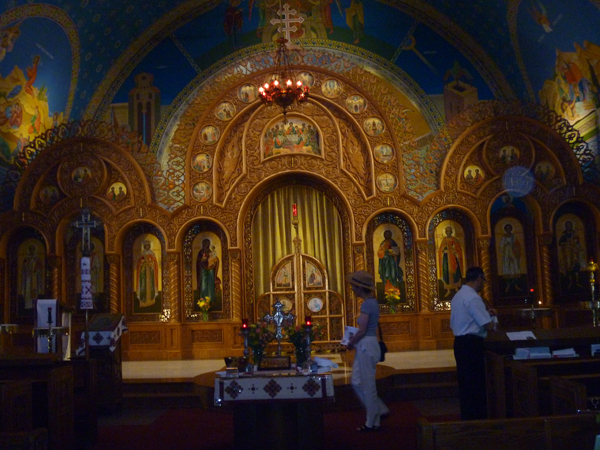
The church was founded in 1968 to perpetuate the traditions of the Ukrainian Church—the Julian Calendar, the traditional Divine Liturgy and its unique spiritual heritage. In 1973, the 11th-13th century Byzantine-Ukrainian style church laid out in the shape of a cross with the altar facing the East and capped with a round gold dome was consecrated. Upon entering the nave, one’s eye is immediately drawn by the exquisitely carved wooden iconostasis with its vivid icons.

Following the tour, the group wound its way back to St. Nicholas Cathedral for an “urban picnic”. While enjoying their fast-food or home-packed lunches, the group shared their impressions of the churches and what especially caught their attention. All agreed that it is easy to understand why those who were sent by Prince Vladimir in his search for the true faith for his people returned after seeing Holy Sophia (Wisdom)Church in Constantinople and exclaimed they had seen heaven. Phyllis Muryn Zaparniuk, in white Ukrainian-style top, joined the group for lunch and shared more Ukrainian Village stories.
Rusyn Food Festival: Ambridge, PA
St. John's Orthodox Church in Ambridge, Pennsylvania will be hosting a Rusyn Food Festival from 2 August to 4 August at the St. John's Orthodox Parish Center. Below are scans from the event's brochure.


28 July 2012

Subscribe to:
Posts (Atom)
